Sunday, November 1, 2009

Namir Hybrid Eco-Powered Concept Cars The"fastest hybrid car in the world."814cc rotary engine 400V lithium polymer battery

Namir Hybrid Eco-Powered Concept Cars

Frazer-Nash, it probably isn't in the context of modern drivetrain technology like hybrid systems. Nonetheless, the brand that was long ago a famous British car maker is still around, albeit no longer building cars. In fact, hybrid drive systems is exactly what Frazer Nash is developing today and the company has collaborated with Italdesign Giugiaro to create a concept called the Namir.Think "hybrid eco-powered car" and you think "Prius" right? Well you shouldn't. You should substitute the mental image of that conventional, if revolutionary auto for the Frazer-Nash Namir from Giugiaro for two reasons. Firstly because it's a whole league of flashiness above Toyota's vaguely bug-eyed design. And secondly because the Namir will top-out at 187 mph....................Namir Hybrid Eco-Powered Concept Cars
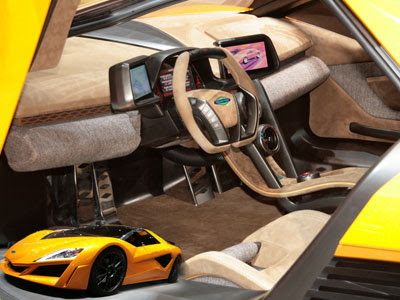
The Namir's was revealed to the public at the Geneva Motor Show, and it's laying claim to the title of "fastest hybrid car in the world." Glancing at the photos you may also think "the most orange-colored hybrid car in the world" would be a fitting title, but I think that the overall super-car-like design mostly excuses the paint work.
Namir Hybrid Eco-Powered Concept Cars

Frazer Nash has developed a series hybrid drivetrain (like the Voltec drivetrain in the Chevy Volt) that uses an 814cc rotary engine driving a generator. The generator charges a 400V lithium polymer battery pack that feeds electrons to a pair of electric motors at each axle with a cumulative output of 362 hp. The system is claimed to give the Namir a top speed of 187 mph, 0-62 mph acceleration in 3.5 seconds while still managing 91.7 mpg (US)! Not too shabby.That acceleration is only just behind the fastest accelerating production car, the Bugatti Veyron, that manages 0-62 mph in 2.45 seconds...though it does so with a quad-turbocharged W16 gasoline engine.In contrast the Namir pushes out just 60kg/km of CO2, or around 60% of the latest road-legal hybrid cars, and manages a fuel efficiency of around 92 miles per U.S. gallon--which is about twice as efficient as driving a Prius. And with a full tank of gas it can go over 1,200 miles without a refill or recharge, and that's a far cry from the early days of hybrid gas-electric cars--incidentally a technology that's been 100 years in the making....................Namir Hybrid Eco-Powered Concept Cars

Those stats are staggering--they make it sound as if we should all be driving Namirs just for the sake of saving the planet. Such a shame that this machine will probably never make it past the concept phase. As Jalopnik puts it: "Odds Of Production: 99,999,000,000-to-1." Though even if it did surpass the "just a dream" stage and make it onto the roads, you can bet its price wouldn't look very different from that number.


Namir Hybrid Eco-Powered Concept Cars

DB-ONE Aston Martin by designer Ruben Vela Super Sports Car Concept


Aston Martin DB-ONE

Ruben Vela, based in Spain designer The Aston Martin DB-ONE concept,product of independent.
The DB-ONE concept is a proposal for an extreme Aston Martin, with classical proportions combined with ultramodern surfaces resulting in a fresh vehicle which also represents the traditions associated with Aston Martin.
In designing the Aston Martin DB-ONE Vela took the elements essential to Aston Martin, large front grille, long bonnet and side vents and created a car with an immense sense of movement, based around the idea of tension - beginning with the grille and moving back towards the rear of the car.
Aston Martin DB-ONE

The body surfaces of the DB-ONE highlight all the power emanating from the proposed 550 horsepower, 6.0 litre, V12 engine even when static. "Cars aren't static objects, so I belive it's important to show dynamism in the design. And this is much more important when you are designing a super-sports car," says Vela.
The rear of the Aston Martin DB-ONE concept is extremely clean due to the small gap in the tail which hides the taillights and a rear diffuser provides a neat finish to the design.
Although the Aston Martin DB-ONE is an independent design created outside the company and exists only on a computer and as a scale model, Aston Martin's new owners, Prodrive, could certainly take note of a few styling ideas introduced by Vela on the DB-ONE concept.

Aston Martin DB-ONE

Racing Car Honda Indy project Concept Car by Yutian Li, the vehicle's designer.


Honda Indy Racing Car

Racing Car Honda Indy project concept has been designed to offer superior aerodynamic performance.
The
Honda and the Indy Racing League was sponsored by Honda Indy Racing Car project. Yutian Li,the vehicle's designer, is a graduate of the Transportation Design course at the College for Creative Studies in Detroit, Michigan. Yutian also holds a bachelors degree in vehicle engineering and a masters in industrial design from Tsinghua University in Beijing, China.
The overall shape of the
Honda Indy Racing Car was inspired by modern architecture - but more specifically Zaha Hadid's work which is greatly influenced by topological patterns found in nature and has a high degree of fluidity and continuity. Yutian applied this theme to vehicle design by using a combination of blended surfaces, and crossing/overlapping shapes in order to bring a whole new look to the future Indy Car Series.

Honda Indy Racing Car


Aside from bringing completely new forms to the racing world, the
Honda Indy Racing Car has also been designed to offer superior aerodynamic performance. The large integrated rear wing located above the engine creates downforce over the rear axle. This downforce is increased once the engine is up at operating temperature because of the pressure difference between hot and cold air. The side panel directs the air to go around the wheels so that rotating drag is reduced. The air box on either side of the driver and the large air intakes in the front ensure sufficient airflow to the engine.
As with all racing vehicles, driver safety in the event of a crash is the utmost priority. The driver of the
Honda Indy Racing Car concept is protected by a structure which was inspired by the shape of leaves. This unit is designed to diffuse the energy of the collision, and at the same time keep the interior cockpit structure intact.
Aside from keeping the rear tires firmly in contact with the track surface, the expansive rear spoiler also acts as a prominent billboard which could make the Indy series more attractive to sponsors. The stripe which divides this spoiler in two contains a thermally sensitive material which changes color depending on engine temperature. This is designed to add more excitement to the race and the spectators.

Peugeot 206 RC 2003


Peugeot 206 RC 2003

Peugeot RC Diamonds 2002


Peugeot RC Diamonds 2002

2002 Peugeot RC Spades


Specifications
Engine Type 2.0 Liter Turbocharged Inline-4
Displacement cu in (cc) 1997 cc / 121.9 cu in
Power bhp (kW) at RPM 1 33.0 kW / 178.4 bhp
Torque lb-ft (Nm) at RPM 202.0 Nm / 149.0 ft lbs
Redline at RPM n.a.
Brakes Ceramic Discs
Tires 245/45R-18
Length 4300 mm / 169.3 in
Weight 900 kg / 1984 lbs
Acceleration 0-62 mphs 6.0 seconds
Top Speed mph (km/h) 230.0 kph / 142.9 mph
Fuel economy EPA (1/100) n.a.
Base Price n.a.

2002 Peugeot RC


Specifications
Engine Type 2L Inline 4
Displacement cu in (cc) 1997.00 cc | 121.9 cu in. | 2 L.
Power bhp (kW) at RPM 181.00 HP (133.2 KW)
Torque lb-ft (Nm) at RPM 202.00 NM (148.9 Ft-Lbs)
Redline at RPM n.a.
Brakes Ceramic Discs
Tires Michelin Pilot 245/45R18
Length 169.001 in | 4292.6 mm.
Weight 1984 lbs | 899.9 kg
Acceleration 0-62 mphs 6 seconds.
Top Speed mph (km/h) 150 mph | 241.4 km/h
Fuel economy EPA (1/100) n.a.
Base Price n.a.